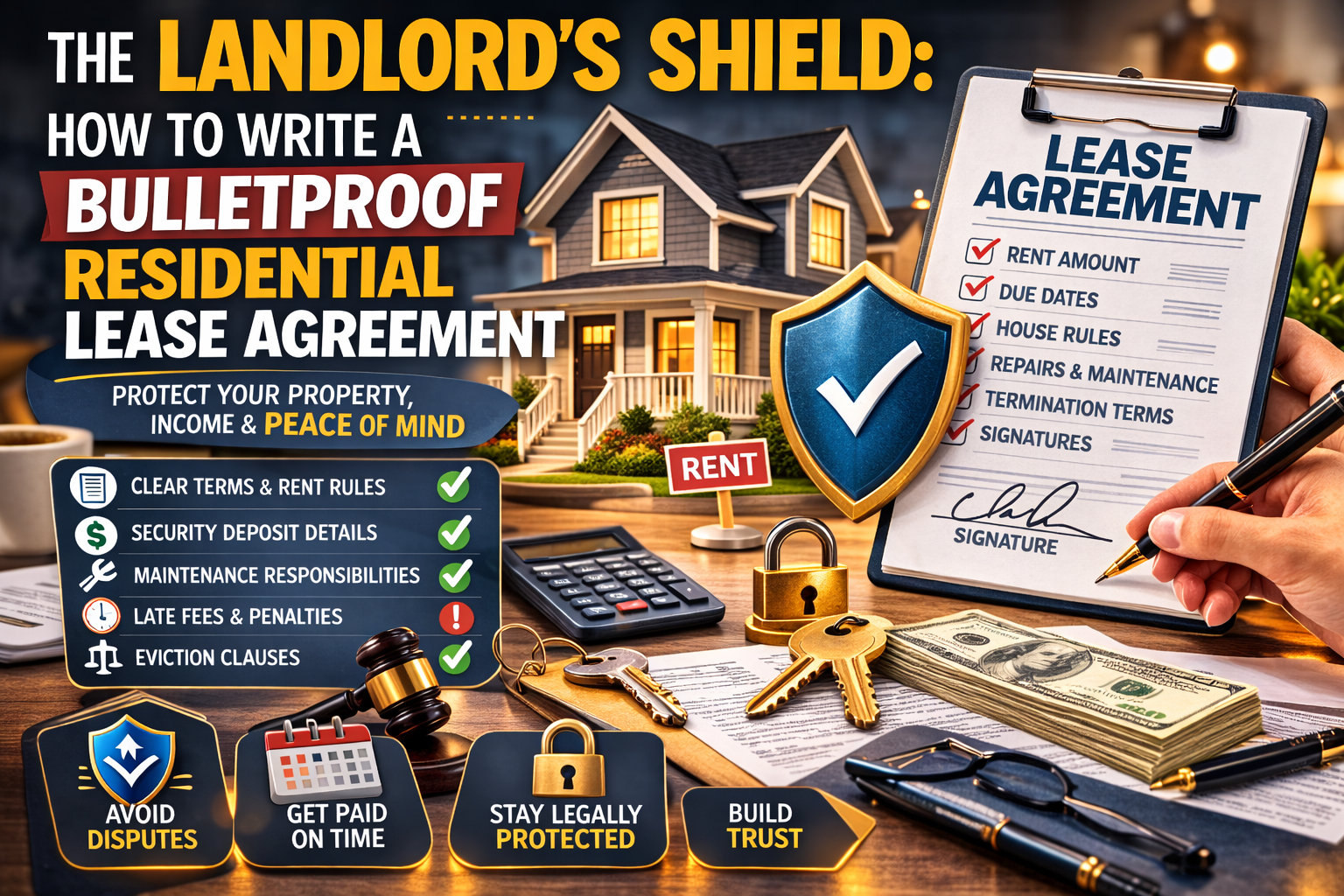
Stop losing sleep over bad tenants. Learn how to draft a Residential Lease Agreement that protects your property, ensures rent, and minimizes legal risks.
Table of Contents
I remember sitting in a courthouse hallway three years ago with a friend named David. He was a first-time landlord who had downloaded a generic, one-page contract from a random website because he thought it would save him a few bucks. Now, he was staring at a massive legal bill and a tenant who hadn’t paid rent in four months but refused to leave. The judge had looked at David’s flimsy contract and sighed. “This isn’t a contract,” the judge said, “it’s a suggestion.”
That was a brutal wake-up call. Whether you are managing a single-family home or a massive portfolio of multi-family properties, your Residential Lease Agreement is the only thing standing between you and total financial chaos.
A lease is more than just a document that says how much the rent is; it is a roadmap for the entire relationship. It defines what happens when the sink overflows, who pays for the landscaping, and exactly what constitutes a “party” that gets someone evicted. If you want to run a successful real estate investment business, you need a document that is airtight. Let’s dive into the essential components of a truly bulletproof Residential Lease Agreement.
The Core Essentials: Beyond the Basics
Most people know they need the names of the tenants and the property address. But a professional Residential Lease Agreement needs to be much more specific.
For instance, you should explicitly list every person who will be living in the home. I’ve seen cases where a single tenant signs the lease, and three weeks later, five “cousins” have moved in, putting massive strain on the plumbing and the neighbors’ patience. By naming every occupant, you ensure that anyone not on that list is considered an unauthorized guest—which gives you the legal standing to take action.
Security Deposits and Financial Clarity
Money is the number one cause of friction in the housing market. Your Residential Lease Agreement must be crystal clear about the security deposit.
Don’t just write down the amount. Specify exactly what that money can be used for (unpaid rent, damage beyond “normal wear and tear,” or cleaning fees). You should also check your local state laws regarding where that money is kept. Many states require you to hold it in a separate interest-bearing account. Failure to do this correctly can result in you owing the tenant three times the deposit amount in some jurisdictions—a mistake that can kill your rental yield for the entire year.
Link to National Association of Realtors: Landlord-Tenant Resources
Maintenance: Who Fixes the Faucet?
One of the most litigated sections of any Residential Lease Agreement involves maintenance. Tenants often assume the landlord is responsible for everything from a burnt-out lightbulb to a clogged toilet.
You need to define the boundaries. A common strategy is to include a “minor repair” clause. For example, the tenant might be responsible for the first $50 or $100 of any non-structural repair. This prevents you from being called at 2:00 AM because a kitchen cabinet handle is loose. Explicitly state that the tenant is responsible for any damage caused by their negligence—like a flushed toy clogging the pipes.
The Importance of House Rules
In residential sales, we talk about curb appeal. As a landlord, you need to protect that curb appeal long after the closing process is over.
Your Residential Lease Agreement should include specific house rules regarding:
- Pets: Be specific about breeds, weights, and “pet rent” or deposits.
- Smoking: I highly recommend a 100% smoke-free policy to prevent permanent odors and fire risks.
- Alterations: Can they paint the walls? Can they install a satellite dish?
- Noise: Define “quiet hours” to stay on the good side of the neighbors and the local HOA.
Link to Wikipedia: Leasehold Estate
Entry and Inspection Clauses
Some landlords make the mistake of thinking they can walk into their property whenever they want. This is a fast track to a lawsuit for “quiet enjoyment” violations.
Your Residential Lease Agreement must outline exactly how much notice you will provide before entering the property (usually 24 to 48 hours). However, you should also include an “Emergency Access” clause. If a neighbor reports water pouring out from under the front door, you need the legal right to enter immediately to save your real estate investment from total destruction.
Default and Eviction Procedures
No one wants to think about a tenant stoping payment, but hope is not a strategy. A bulletproof Residential Lease Agreement must clearly define what constitutes a default.
Is rent late on the 2nd or the 5th? What is the daily late fee? If the tenant violates the “no-pet” policy, how many days do they have to fix it before the lease is terminated? Having these steps written out in black and white makes the legal process much smoother if you eventually have to head to court. It removes the “he-said, she-said” drama that judges absolutely loathe.
Incorporating Local and Federal Laws
A Residential Lease Agreement that violates the Fair Housing Act isn’t worth the paper it’s printed on. You cannot discriminate based on race, religion, or familial status.
Furthermore, many cities have specific “just cause” eviction ordinances or rent control laws. If your lease doesn’t reflect these local realities, it could be ruled invalid. I always suggest having a local real estate attorney or an experienced property management professional review your draft. They can spot the tiny, state-specific phrases that keep you out of trouble.
The Move-In/Move-Out Inspection
While not technically part of the text of the Residential Lease Agreement, the “Condition of Premises” report should be an official addendum.
Take hundreds of photos and a video walkthrough before the tenant moves in. Have the tenant sign off on a checklist acknowledging that the walls are clean and the appliances work. When it’s time for them to move out, this document is your best friend. It allows you to prove that the giant hole in the drywall wasn’t there when they arrived, making it much easier to justify withholding part of the security deposit.
Why Electronic Signatures are a Game Changer
In the modern housing market, convenience is king. Using a secure platform to sign your Residential Lease Agreement digitally is often better than paper.
Digital platforms provide an “audit trail,” proving exactly when the document was signed and from which IP address. This prevents a tenant from later claiming they “never saw that page” of the contract. It also makes it easier to store the document in your digital database for quick reference when a tenant calls with a question about their utility responsibilities.
Conclusion
Writing a Residential Lease Agreement isn’t about being a “mean” landlord. It’s about being a professional one. It’s about setting clear expectations so that everyone is on the same page from day one.
When you have a solid contract in place, you can stop worrying about the “what-ifs” and start focusing on the rental yield and the long-term growth of your property. Take the time to do it right. Don’t rely on a free template you found in a dark corner of the internet. Invest in a high-quality, legally vetted Residential Lease Agreement today, and you’ll save yourself a mountain of stress and money tomorrow.
Have you ever had a lease save you from a nightmare situation? Or maybe you’ve been caught without a specific clause you really needed? Drop a comment below and share your landlord battle stories!
FAQ Section
1. Is a verbal Residential Lease Agreement legally binding? In many states, yes, but it is a terrible idea. Without a written document, you have no way to prove the agreed-upon rent, the duration of the lease, or who is responsible for repairs. A verbal agreement is almost impossible to enforce in an eviction court.
2. Can I change the terms of the Residential Lease Agreement mid-year? Generally, no. Once both parties sign, the lease is a fixed contract. If you want to change something, both you and the tenant must sign a written “Lease Amendment.” Otherwise, you have to wait until the lease expires to change the terms for the next year.
3. What happens if the tenant breaks the Residential Lease Agreement early? Your lease should include an “Early Termination Clause.” This usually requires the tenant to pay a fee (often two months’ rent) or continue paying rent until you find a new, qualified tenant. This protects your cash flow during the transition.
4. Should I include a “No AirBnB” clause in my Residential Lease Agreement? Absolutely. Unless you want your property turned into a de facto hotel, you should explicitly prohibit sub-leasing or short-term rentals on platforms like AirBnB or VRBO. This protects your insurance coverage and keeps the neighbors happy.
5. How often can I increase the rent in a Residential Lease Agreement? Typically, you can only increase the rent when the lease term expires. If you have a month-to-month agreement, you can usually increase it with 30 or 60 days’ notice, depending on your local state laws and any rent control ordinances in your city.
